
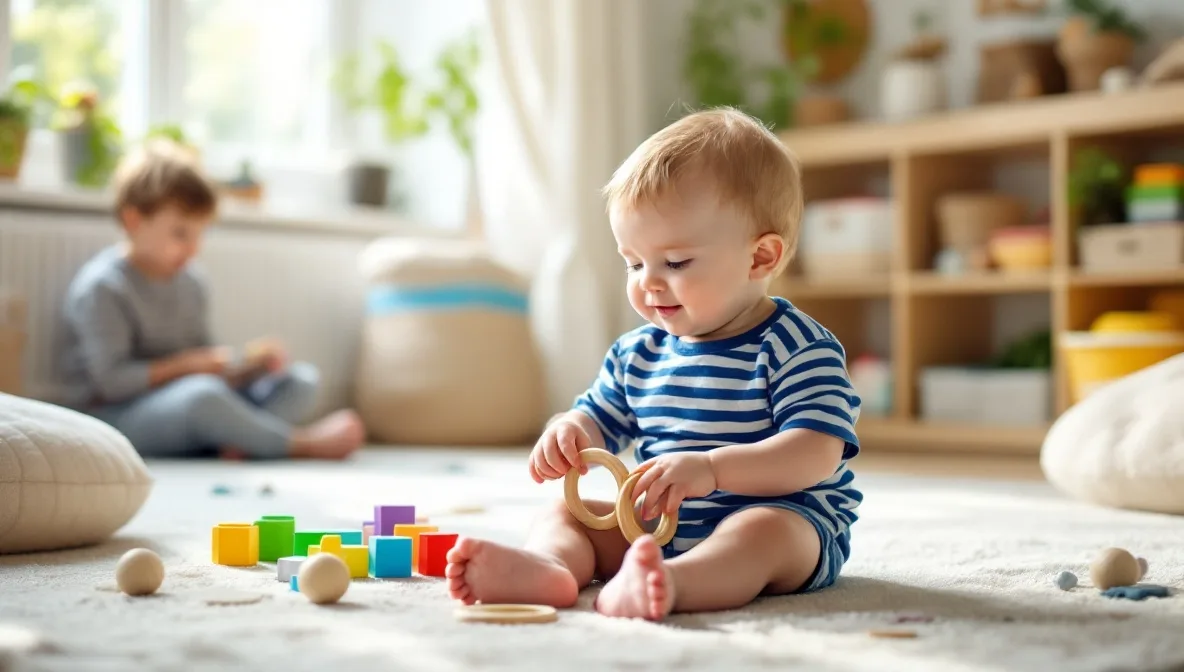
How to encourage independent play for 2-year-olds starts with understanding that independent play is not about leaving your child alone, but about creating an environment and building the skills that let your toddler feel confident playing without constant parental direction. At two years old, your child is developmentally ready to play by themselves for short periods—but only if you set up the right space, choose the right toys, and use a gradual approach to extend their playtime stamina. This guide walks you through everything you need to know to teach your toddler to play by themselves safely and joyfully.
Key Takeaways
- Independent play at age two builds self-regulation, fine motor skills, and intrinsic satisfaction—start with 5–10 minute blocks and extend gradually.
- A "yes space" (a childproofed area filled with low shelves of open-ended toys) is the foundation for independent play success.
- Rotate toys every 1–2 weeks to maintain novelty and prevent over-stimulation without buying constantly.
- Use timer training to help your child understand playtime duration and build capacity from short bursts to 20–30 minutes by age three.
- Parallel play (you playing quietly nearby) bridges the gap between constant attention and full independence.
What Independent Play Looks Like at Two Years Old
At 24 months, your child's brain is developing rapidly, and independent play supports crucial milestones in visual perception, fine motor skills, and self-regulation. Two-year-olds are not yet capable of true imaginative play—they explore objects, repeat actions, and begin to notice cause-and-effect. This is the sweet spot for learning to occupy themselves without needing your entertainment or validation every few seconds.
Independence at this age doesn't mean a child never checks in with you. Expect your two-year-old to glance over, smile, or bring you a toy to show. These micro-connections are normal and healthy. The goal is for your child to return to their own play, sustained and focused, for stretches of 10–15 minutes—a dramatic leap from the 2–3 minute bursts many toddlers manage without structure.
Set Up a Yes Space: The Foundation for Independent Play Activities
A "yes space" is a concept drawn from Magda Gerber's Resources for Infant Educarers (RIE) approach: a completely childproofed area where your two-year-old can explore freely without you saying "no." Unlike a play pen, a yes space gives your child agency and safe choices.
How to Build Your Yes Space
- Childproof ruthlessly. Remove cords, cover outlets, lock cabinets, secure furniture to walls, and remove anything with small parts or sharp edges. Your child should be able to pull, throw, taste, and climb without injuring themselves.
- Use low, open shelves. Mount rotating shelves or buy a simple wooden bookcase (24–30 inches tall) so your two-year-old can see and grab toys independently. Closed bins hide toys and reduce choice; open shelves invite exploration.
- Group toys by type. Place wooden blocks on one shelf, sensory bins on another, and dramatic play items (pots, spoons, fabric) on a third. This visual organization helps your child self-select and clean up more easily.
- Add a soft play area. Include a cushioned mat, rug, or low couch where your child can rest or create a cozy spot. A yes space is not just for activity—it's a complete environment.
- Limit décor and clutter. Too many toys or bright posters create over-stimulation. Keep walls neutral and shelves uncluttered so your child's brain has space to focus.
A well-designed yes space removes decision paralysis and the need for you to constantly redirect or supervise. Your two-year-old can safely explore, and you can sit nearby with a book or work, present but not hovering.
Choose Open-Ended Toys for Sustained Independent Play
Age-appropriate toys for independent play toddlers are open-ended: they have no one "right" way to use them, which means your child can return to them again and again, discovering new possibilities. Closed-ended toys (those with a single purpose or button-pushing feature) capture attention briefly but leave little room for exploration.
| Open-Ended (Best for Independent Play) | Closed-Ended (Limit These) |
|---|---|
| Wooden blocks and stacking rings | Electronic toys with light-up buttons |
| Sensory bins (rice, pasta, water beads) | Single-purpose shape sorters |
| Fabric scraps, scarves, and blankets | Toys that "teach" with sounds |
| Wooden spoons, pots, and pans | Action figures with tiny accessories |
| Play dough and safe natural materials | Items requiring frequent battery changes |
Research on independent play in toddlers shows that open-ended toys extend engagement and build intrinsic satisfaction—your child plays because they enjoy it, not because the toy does something for them. Wood, fabric, and natural materials also tend to feel calming and reduce sensory overload compared to plastic with bright colours and sounds.
Rotate Toys: The Secret to Novelty Without Excess
Rotating toys for toddler independent play is one of the most underused strategies. Instead of having 50 toys out, keep 8–12 on shelves at any time and swap in new ones every 1–2 weeks. This maintains novelty (your child feels they have "new" toys regularly) without over-stimulation and keeps the space visually calm.
A Simple Rotation Schedule
- Monday: Display blocks, rings, and fabric scraps.
- Wednesday: Swap blocks for sensory bins and wooden spoons.
- Friday: Introduce play dough, containers, and scoops.
- Sunday: Rotate back to earlier items with fresh eyes and renewed interest.
Many parents find that rotating toys also rediscoveries old favourites. A set of blocks your two-year-old ignored last month becomes irresistible after a break. You'll spend less on toys and see longer, more focused play sessions as a result.
Build Stamina with Timer Training: The Critical Step Most Parents Miss
Timer training is the bridge between a beautiful yes space and your child actually using it independently. You're not just setting up an environment; you're teaching your two-year-old that playtime has a beginning, middle, and end, and that their job is to stay focused until the timer sounds.
How to Start Timer Training
- Begin with 5 minutes. Set a visual timer (sand timer or kitchen timer your child can see or hear) and sit nearby, doing your own quiet activity. Don't interrupt your child unless there's a safety issue.
- Extend by 2–3 minutes each week. If your child plays for 5 minutes consistently, move to 7 or 8 minutes the next week. By age 2.5, most children can sustain 15–20 minutes. By three, 20–30 minutes is realistic.
- Use the timer as a guide, not a strict boundary. If your two-year-old is deeply engaged and the timer goes off, you can say "the timer finished, but I see you're still playing—that's great!" Continue for a few more minutes. This builds intrinsic satisfaction and shows your child that their engagement matters.
- Celebrate the finish. When the timer sounds, praise your child: "You played for 10 whole minutes! I'm proud of how you played with those blocks."
How long should a 2-year-old play independently? The answer is not a fixed number—it's a range that grows with practice. Start with 5–10 minutes and gradually extend as your child's self-regulation improves. Parents who use incremental timer training report the quickest progress toward sustained play.
Parallel Play: The Bridge to Full Independence
Parallel play—where you sit nearby and do your own activity while your child plays—is not the same as independent play, but it's an essential stepping stone. Your presence without direction teaches your child that quiet, focused time with you nearby feels safe and normal.
To use parallel play effectively, sit on the floor or a chair close to your child's yes space. Read a book, fold laundry, or work on your laptop. Don't narrate their play ("Oh, you stacked a red block!"), ask questions, or offer suggestions. Your job is to be present and calm, not entertained. Over weeks, gradually move further away or spend more time focused on your own task. Your child will internalize the quiet, contented vibe and begin to self-direct more naturally.
Why Your Toddler Struggles with Independent Play (And How to Address It)
If your two-year-old won't play by themselves, there are usually a few culprits. An under-stimulated yes space (boring toys or too few choices) sends a message: "There's nothing here worth doing alone." Over-stimulation (too many toys, bright colours, or noise) overwhelms your child's developing nervous system, making them seek your calm presence instead. In other cases, your child has learned that demanding attention gets results—you've inadvertently trained them to interrupt rather than engage independently.
The solution is to audit your yes space, commit to parallel play for 2–4 weeks, and use consistent timer training to build the habit. Change doesn't happen overnight, but most children show measurable progress within 3–4 weeks of a structured approach.
Frequently Asked Questions
How do I start my 2-year-old playing independently?
Start by creating a yes space with low shelves, open-ended toys, and a completely childproofed area. Then use parallel play (sit nearby, doing your own quiet activity) for 15–20 minutes daily while your child plays. Introduce timer training after a few days, starting with 5 minutes and extending gradually each week.
What are the best toys for a 2-year-old to play alone?
Open-ended toys like wooden blocks, stacking rings, sensory bins, fabric scraps, play dough, and kitchen items (pots, spoons, bowls) are ideal. Avoid toys with batteries, buttons, or a single purpose. Rotate toys every 1–2 weeks to maintain novelty and focus your child's attention.
How long should a 2-year-old play independently?
Begin with 5–10 minutes of sustained play and extend by 2–3 minutes weekly. Most two-year-olds can manage 15–20 minutes by age 2.5, and 20–30 minutes by age three. Use a visual timer to make the expectation clear and celebrate progress.
What is a yes space and how do I make one for my toddler?
A yes space is a completely childproofed room or corner where your two-year-old can explore safely without hearing "no." Set up low, open shelves with toys grouped by type, remove all hazards, and add a soft play area. The goal is to let your child choose and explore independently.
Should I leave my 2-year-old alone to play for a short time?
Brief periods of independent play (10–15 minutes) in a supervised yes space are safe and developmentally appropriate at age two. Always ensure your child is in a childproofed area, you can hear or see them, and you return promptly when the playtime ends. Never leave a two-year-old unsupervised for extended periods.
Building independent play habits takes patience and consistency, but the payoff is enormous: your two-year-old gains confidence, you get 20 quiet minutes to yourself, and your child develops real skills in focus, creativity, and self-soothing. Start small with your yes space, commit to parallel play and timer training, and you'll see your toddler bloom into a capable, engaged player within weeks.
Comments 0
Please Sign in to leave a comment.
No comments yet. Be the first to share your thoughts!